Monday, September 22, 2008

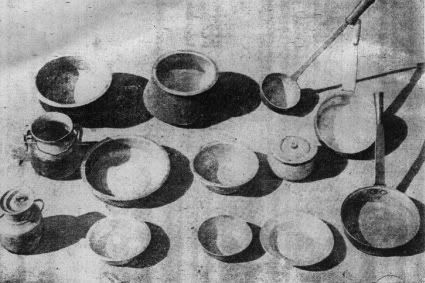
The Evolution of Pots and Pans


The Evolution of Pots and Pans

In the earliest days of the primitive human race, food was cooked over an open flame or placed on hot rocks which were heated in an open flame. As time progressed and civilization marched on, the invention of dishes came along. With the ability to boil water in a controlled environment, suddenly a multitude of new recipes and new methods of cooking became available to everyone.

As time progressed, the simple concept of food preparation items has become a veritable forest of options and choices for the skilled cook, with no shortage of fancy pots and pans to choose from. With Teflon cookware coatings, nonstick surfaces and all manner of new improved cookware items, the dishes in the modern day are truly amazing and serve a variety of functions.

It's interesting to note that in the earliest days of mankind; simply boiling a pot of water was almost an insurmountable task. While there are all manner of archaeological findings which gave credence to the idea that the earliest dishes were clay, even before these clay dishes came along there was a need for heating and cooking of food, even before sanitary food preparation came along.

Many times, these foods were cooked on hot rocks, over an open flame or simply eaten raw. It is a commentary on how advanced our civilization has become that we no longer depend on these somewhat unappealing and difficult methods of preparing food with limited cookware.

In fact, some products such as pots and pans are so advanced in the modern day that we have eliminated much of the difficulties of cooking altogether. Simply flick a switch and the gas instantly comes on. Push a button and a timer is set. By utilizing all these modern-day functions, in addition to the aforementioned revolutionary invention of pots and pans, cooking in the modern day has become routine, even boring in some cases.

While it seems somewhat commonplace, some of the revolutionary breakthroughs with pots and pans include pressure cookers, slow cookers and crock pots, staples of the modern-day kitchen. But these items were not always so common and quite often preparing food in primitive times was more of an adventure than a chore.

From chopping up firewood to getting a roaring flame started, all the way down to applying the food to open heat, the difference between cooking in primitive times compared with the modern day with cookware is like night and day. There really is no comparison, as we have grown so efficient and so simple that it is no longer even in doubt how easy it is to prepare food.

Fortunately, along with the pace of civilization, the evolution of pots and pans has kept up nicely. With the ability to prepare food on nonstick surfaces in stainless steel pots and pans and other types of modern-day cookware implements, the modern day cook can focus solely on preparation of the food, rather than dealing with all of the external and peripheral difficulties of primitive life. Rather than piling up firewood and starting a fire, the modern-day cook simply turns on the stove burner.

In primitive times, the food would have been cooked on a spit or laid on a flat hot rock. Today, we simply chuck these products into a pan and set the timer, confident that our food will be cooked correctly thanks to modern technology. With such modern conveniences, it is no surprise that so few people make the effort to go back to nature and live on the land as our forebears were so accustomed to.

It is easy enough to take the evolution of pans for granted, but without these extremely fascinating leaps in technology, we would very likely still be cooking food with a hot rock or holding our meat over an open fire. The wonders of modern technology have brought us a long way and mankind has made great advances, not the least of which is the way in which we prepare our food.

Without these leaps in technology, mankind would still be subject to all manner of difficulties, not to mention parasites that are easily spread through uncooked foods and unclean surfaces. After all, cooking food on a big rock can't be all that sanitary.

Granny Talks in the Kitchen

In my last article I told that I had decided to try out the boat job. I was scared to death. All I could think about was what if I got sick? How would I get off the boat in the middle of the river? What if they didn't like me? What if I didn't like them? What if I ran out of cigarettes? I had no clue what I was getting into. Was it going to be like "Loveboat " or "Pirates of the Pacific?" None of the above.

I showed up for work at the office at 7am. I live two hours away so I was a little early. There were two or three guys standing around with their suitcases, pillows, a stereo, and cases of drinks. Boy, did I pack light! I had a suitcase full of cigarettes and Excedrins.

Shortly, a man in a van pulled up. He opened the back doors and the guys all started loading their stuff. One came up to me and asked if I was Cookie. I said no, Patricia, I am the cook. The driver started laughing and said "yep, that's the new cook." They call all the cooks "Cookie" I found out. One grabbed my suitcase and put it in the van. I asked where we were going. They said we were going to meet the boat, which was five hours away. This gave me plenty of time to find what the deal was.

They told me they didn't really care what it was, as long as there was plenty of it. The captain liked biscuits and gravy for breakfast. I was looking to impress the captain because he was my boss.

By the we time got to the boat it was late. Everyone was sitting around the table talking and waiting on us. When we got loaded and unloaded they all introduce themselves. We talked a few minutes then I asked where the captain was. One piped up and said "I am the captain". My eyes and mouth flew open and I said "You are the captain?" Everybody laughed and I felt right at home after that.

The next morning I went to the "galley" to cook breakfast. I made about three or four dozen bisquits along with bacon, sausage, fried bologna and, of course, gravy. The captain came down to see if I had found everything. He took one look at the bisquits and just died laughing. When they all came in for breakfast, they all had something funny to say about me cooking a months worth of groceries at one meal. So was my first day as a river boat cook. What took me so long?

I don't think there is a real recipe for "cathead bisquits" or "sawmill gravy". But I will tell you how I do it. It must be good because when I was ten years old my brother of seven years wanted me to make the bisquits on Saturday mornings.

The first thing is to get everything ready. Turn your oven on to 350 degrees. Grease a baking pan. If you are going to roll them out, prepare your spot. I use a piece of waxed paper with plenty of flour on it. If you plan to make drop bisquits you need nothing else. You can also use a bowl with flour in it and just drop a spoonful of dough in it. Roll it around to cover with flour and make a small patty out of it. My grandma always told me not to play the bisquits. Mix them and be done with it. According to how many you want, use about two cups of self-rising flour. Add about one healthy heaping tablespoon of Crisco.(Or another good quality solid shortening). Cut this into the flour using a fork, two knives, pastry cutter, or better still, your fingers. Don't make it like cornmeal but mix it pretty good. Next, add about one half cup or so buttermilk. If you don't have buttermilk, use regular milk. Even water will do but the less fat content of your liquid, the tougher your bisguits will be. Mix with the quickness. Try to add liguid once. You just have to do it a few times to get the feel of it.

Now you are ready to roll them out. Turn a couple of times to cover with flour. Roll out to about one half inch thick. Dip your cutter in flour to keep it from sticking to the dough and go to cutting. Place on a greased baking pan and top with a spoon of melted grease from bacon or whatever you got. Bake untill brown.

Now for the gravy. Use the skillet you used for frying the bacon or put enough grease in a skillet to cover the bottom real good. Add a couple spoons of flour, salt and a plenty of black pepper. Cook on medium high to high untill your flour is browned. Add a couple cups of milk and turn the heat down to medium. Add water if it is too thick. Cook untill it is as thick as you want. You can also make the gravy with all water. I think that is real sawmill gravy.

Did you know red-eye gravy came from the people who went west on the wagontrain? They used coffee to clean thier iron skillets and sopped up the "gravy" with bisquits. Interesting huh?

Thursday, September 11, 2008

Comptia Exam Preparation - A Plus Essentials

After you study your text books it is important to test your newly acquired knowledge and see just how well you have absorbed the material. Practice exams....

* Reinforces what you learnt - fill in the gaps of what you missed
* Gets you used to answering questions to build confidence and familiarity

Here are 15 True/False exams questions for you to practice on:

Q.1 - FAT32 is the file system Windows XP uses for encryption. True/False

Q.2 - Ad-hoc is the wireless technology used to describe a direct wireless connection between two pcs. True/False

Q.3 - A RJ-45 connector is used to connect a telephone modem to the telephone service provider for a 56k modem. True/False

Q.4 - To inspect the hard disk drive for errors, we use the Defrag program. True/False

Q.5 - To see the number of operating systems that can be booted on a PC running Windows XP, you would view the BOOT.INI file. True/False

Q.6 - The Drums of a laser printer and not photosensitive and it's ok to expose them to light. True/False

Q.7 - A Line Analyzer is used to check for line-voltage sags. True/False.

Q.8 - If you replace a floppy drive in a PC and the FDD light is constantly on when you boot, this means that you have connected data ribbon backwards. True/False

Q.9 - If you forget the password you have entered for the BIOS, you can reset the CMOS jumper and it will change it to the default which is no password. True/False

Q.10 - POST error codes starting with 2 indicate a memory related problem. True/False

Q.11 - With msconfig.exe you can access start up files like Win.ini, System.ini and Boot.ini. True/False

Q.12 - Receiving a 'Bad or missing COMMAND.COM' error messages can be caused from having an older version of COMMAND.COM or a corrupt COMMAND.COM. True/False

Q.13 - The command Fdisk is used in Windows XP to create a disk partition. True/False

Q.14 - If the power supply ceases to work, the best cause of action is to open up the power supply and fix the problem. True/False

Q.15 - For the command prompt to appear, we type 'cmd' in the Windows XP run dialog box. True/False

Comptia Exam Preparation A plus Essentials Answers

The questions along with the answers are included in this comptia exam preparation for your better convenience

Q.1 - FAT32 is the file system Windows XP uses for encryption. True/False

False. Its actually NTFS

Q.2 - Ad-hoc is the wireless technology used to describe a direct wireless connection between two pcs. True/False

True

Q.3 - A RJ-45 connector is used to connect a telephone modem to the telephone service provider for a 56k modem. True/False

False. A RJ-11 connector is used.

Q.4 - To inspect the hard disk drive for errors, we use the Defrag program. True/False

False. We use the Chkdsk program.

Q.5 - To see the number of operating systems that can be booted on a PC running Windows XP, you would view the BOOT.INI file. True/False

True

Q.6 - The Drums of a laser printer and not photosensitive and it's ok to expose them to light. True/False

False. They are photosensitive and should not be exposed to light.

Q.7 - A Line Analyzer is used to check for line-voltage sags. True/False.

False. A Polarity Tester is used.

Q.8 - If you replace a floppy drive in a PC and the FDD light is constantly on when you boot, this means that you have connected data ribbon backwards. True/False

True

Q.9 - If you forget the password you have entered for the BIOS, you can reset the CMOS jumper and it will change it to the default which is no password. True/False

True

Q.10 - POST error codes starting with 2 indicate a memory related problem. True/False

True

Q.11 - With msconfig.exe you can access start up files like Win.ini, System.ini and Boot.ini. True/False

True

Q.12 - Receiving a 'Bad or missing COMMAND.COM' error messages can be caused from having an older version of COMMAND.COM or a corrupt COMMAND.COM. True/False

True

Q.13 - The command Fdisk is used in Windows XP to create a disk partition. True/False

False. The command Diskpart is used.

Q.14 - If the power supply ceases to work, the best cause of action is to open up the power supply and fix the problem. True/False

False. The power supply shouldn't ever be opened. You should replace it.

Q.15 - For the command prompt to appear, we type 'cmd' in the Windows XP run dialog box. True/False

True